


Kettlebells Build Strength Safely When Technique Comes First
Are kettlebell workouts safe to do at home or at the gym? Kettlebells are safe and effective for most people when you learn proper technique, start with an appropriate weight, and progress gradually. Most kettlebell injuries do not come from the tool itself, as they come from rushing the hip hinge, choosing too heavy a bell, or repeating a flawed pattern until the lower back complains.
A single kettlebell trains strength, power, and cardiovascular endurance in one compact package, which is why it works equally well in a spare corner at home or a busy gym floor. The offset weight (the load hangs below the handle) forces your core and stabilizers to work through every rep, and that same feature is what punishes sloppy form. Get the fundamentals right, and a kettlebell becomes one of the most efficient tools you can own. Skip them, and you will meet your lower back the hard way.
The Hip Hinge Drives Every Safe Kettlebell Swing
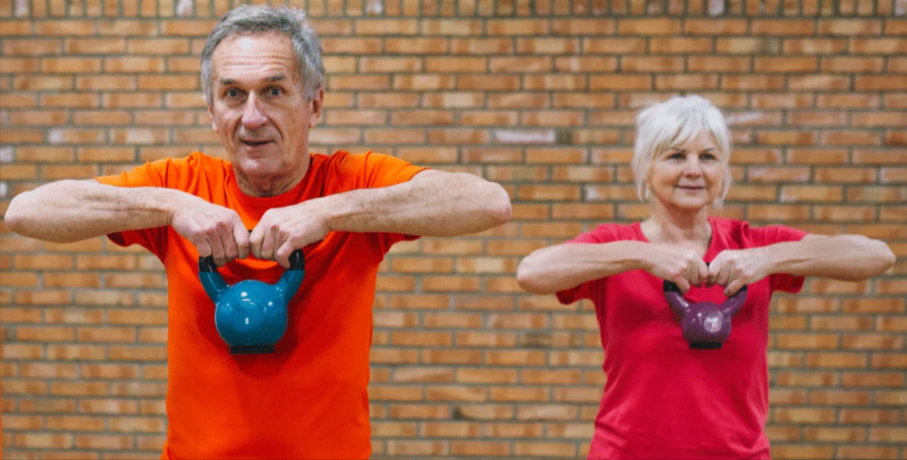
What is the most important skill for safe kettlebell training? The hip hinge is the foundational movement behind safe kettlebell training, especially the swing, and getting it wrong is the number one cause of back strain. A swing is powered by your hips snapping forward, not by squatting down and standing up, and not by lifting the bell with your arms or lower back.
To groove the pattern: stand with feet hip-width apart, push your hips backward as if closing a car door with your rear, keep a soft bend in the knees, and maintain a flat, neutral spine. The bell floats to chest height from hip drive, not shoulder effort. Bracing your core and glutes at the top protects your spine and finishes the movement in a tall, stacked position. Practice the hinge with no weight, then a light bell, before you ever swing anything heavy.
Beginners Should Start Light and Progress Gradually
What weight kettlebell should a beginner start with? Beginners should start lighter than they expect and master mechanics before adding load, because a bell that is too heavy forces you into compensations that cause injury. It is far easier to add weight later than to unlearn a back-rounding swing built with a bell you could not control.
A common starting range for general fitness is roughly 8–12 kg (about 18–26 lb) for many adults, though the right number depends entirely on your strength, history, and the specific exercise, such as swing tolerates more weight than an overhead press. The rule that matters more than any number: if your form breaks down before your muscles fatigue, the bell is too heavy. Train consistently two to three times per week, keep movements controlled, and stop if you feel pain rather than effort. Progress the load only once the pattern is clean and repeatable.
A Beginner-Safe Kettlebell Session Covers Hinge, Squat, Push, and Carry
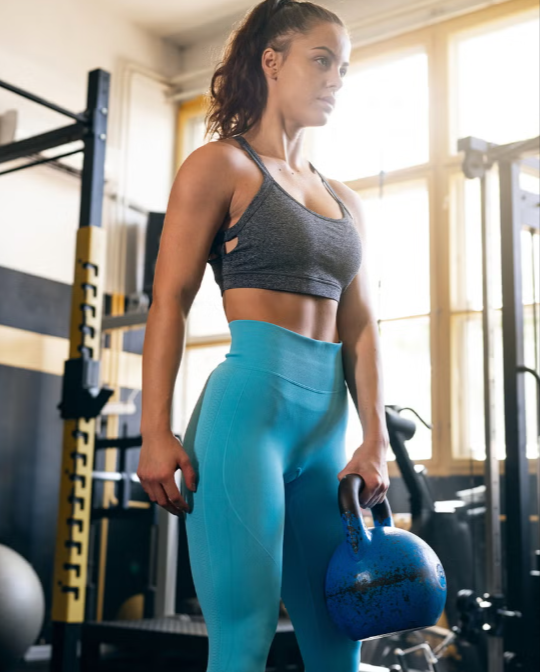
What does a safe starter kettlebell workout look like? A safe beginner session covers the four fundamental patterns, including hinge, squat, push, and carry, with light weight and clean form. These movements build real-world strength without the technical risk of advanced ballistic lifts like snatches.
- Goblet squat — hold the bell at your chest; sit down between your hips, chest tall, knees tracking over toes.
- Kettlebell deadlift — the hinge with the bell on the floor; the safest way to learn to load your hips before you swing.
- Halo — circle the bell around your head slowly to open the shoulders and warm the upper body.
- Single-arm press — press overhead with a neutral wrist and braced core; do not let the lower back arch.
- Suitcase carry — walk while holding the bell at one side; a simple, safe way to build core and grip stability.
- Russian swing (once the hinge is solid) — hip-driven swing to chest height, not overhead, to start.
Warm up for five to ten minutes first, and treat rest days as part of the program as recovery is when strength is actually built.
Certain People Should Check With a Physical Therapist Before Swinging
Who should be cautious with kettlebell training? Anyone with a history of back or shoulder injury, current pain, balance concerns, pregnancy or recent postpartum status, or a long gap in training should get guidance before starting kettlebells. The ballistic, dynamic nature of some kettlebell movements amplifies whatever compensations you already carry.
This is also where kettlebells shine for populations that are often told to avoid loading. Research has linked kettlebell training to improved core strength and balance in older adults, and better balance is directly protective, as falls are a leading cause of serious injury in adults over 65. The catch is that these are exactly the people who benefit most from learning the patterns under supervision first. A physical therapy clinic near you can screen your hinge, tailor the load, and clear you to train hard with confidence rather than caution.
Why Contact Red Rock Physical Therapy

A kettlebell is only as safe as the hip hinge behind it, and that pattern is exactly what a physical therapist is trained to assess. Whether you are new to training, returning after an injury, or an older adult who wants the balance and strength benefits without the risk, we can screen your movement, correct the hinge before it costs you a back tweak, and build a progression that fits your body. Our team has particular depth in balance and fall prevention, orthopedic strength, and golf-fitness conditioning, so we can meet you wherever you are. No referral is needed to start in Illinois, and every session is one-on-one.
McHenry Physical Therapy Review
Red Rock Physical Therapy is a gem tucked away in McHenry. The staff is knowledgeable and friendly. They are willing to work with your schedule to get you in to receive care. They are concerned with your well being and safety. I recommend them to anyone needing physical therapy.
Shawn Smosna
Rating: 5/5 ⭐⭐⭐⭐⭐
Shawn Smosna, April 4, 2020
Read more of our client reviews on our Google profile!
Frequently Asked Questions
Are kettlebells safe for beginners?
Yes, when you start with a light bell, learn the hip hinge before swinging, and progress gradually. Most beginner injuries come from too much weight too soon or a swing powered by the back instead of the hips.
What weight should I start with?
Many adults start around 8–12 kg (18–26 lb) for general fitness, but it depends on your strength and the exercise. If your form breaks before your muscles fatigue, the bell is too heavy.
Are kettlebell swings bad for your back?
No — a properly hinged swing is powered by the hips and protects the spine. Swings become risky only when people squat-and-lift the bell or round the lower back. Learn the hinge first.
Are kettlebells good for people over 50 or seniors?
They can be excellent for building strength and balance, both of which help prevent falls. Older adults benefit most from learning the movements under professional guidance before adding load.
How many days a week should I train with kettlebells?
Two to three sessions per week is a solid starting point, with rest days in between so your body can recover and adapt.
When should I see a physical therapist about kettlebell training?
If you have a history of back, hip, or shoulder injury, current pain, balance concerns, or you are pregnant or postpartum, get screened first. A PT can check your hinge and tailor a safe program.
Contact Us
Red Rock Physical Therapy & Wellness
5435 Bull Valley Rd, Suite 110
McHenry, IL 60050
Phone: 815-451-4502
Hours: Mon–Thurs 8am–7pm · Fri 8am–3pm · Sat–Sun Closed
Proudly serving McHenry, Crystal Lake, Woodstock, Lakewood, Lake in the Hills, Wonder Lake, Johnsburg, Ringwood, Algonquin, Huntley, and surrounding McHenry County and Southern Wisconsin communities.

Written & Reviewed By
Dr. Deborah A. Mitchell, PT, DPT, MPT
Doctor of Physical Therapy
Red Rock Physical Therapy & Wellness · McHenry, IL
APTA Private Practice Member · NPI 1417975566
Dr. Deborah “Debbie” Mitchell is a Doctor of Physical Therapy at Red Rock Physical Therapy & Wellness in McHenry, Illinois, with more than 20 years of clinical experience treating orthopedic, neurologic, and sports-related conditions. She earned her Doctor of Physical Therapy from Temple University (2006), and holds a Master of Physical Therapy (2002) and a B.S. in Health Science from Bradley University. Her own recovery from a serious car accident at 18 shaped her whole-person, hands-on approach and led her to specialize in the John F. Barnes Myofascial Release Approach®. Her clinical focus includes manual therapy, dry needling, balance, back pain, and fibromyalgia, and she serves as a Certified APTA Clinical Instructor.
Practice
Therapy · Temple ’06
(2014 & 2015)